Agentic translation
In agentic systems, AI doesn't just generate text. AI actually decides what to do next in a workflow.
Translation is the original generative task. It was the first task to shift to humans checking and fix what AI generated. Transformer models rolled out in 2017.
But translation workflows remained basically hard-coded in the 2010s. Either every new machine translation went to manual check and fix, or nothing did. Either slow and expensive, or trash quality.
Now with agentic translation, AI like ModelFront decides when to trigger automatic post-editing, and, most importantly, when to trigger human intervention.
Working inside a TMS, it uses quality prediction to route each segment to the best path, whether automatic post‑editing or manual human post-editing, instead of hard‑coding the same path for every new segment in a file or project.
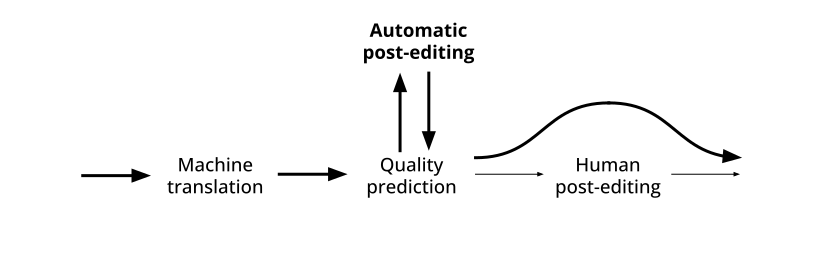
Agentic systems make sense and are already creating significant value in the real world. In translation, ModelFront is used to route billions of tokens.
Like with AI itself, the word "agentic" is abused. It is often confused with "touchless" workflows, with zero human intervention.
But the value is in automating and keeping human quality.
“It's not hard to make things different, but it is hard to make things different and better.” — Jeff Bezos
An agentic system that keeps human quality requires humans for training, evaluating, monitoring and re-training. And an AI age triggering human intervention during work.
Join the mission
Are you interested in joining the mission to accelerate human-quality translation?
Browse jobs at ModelFront